Weekly Evening of the ACADEMION Cultural Platform (Culture of Tolerance with Others)
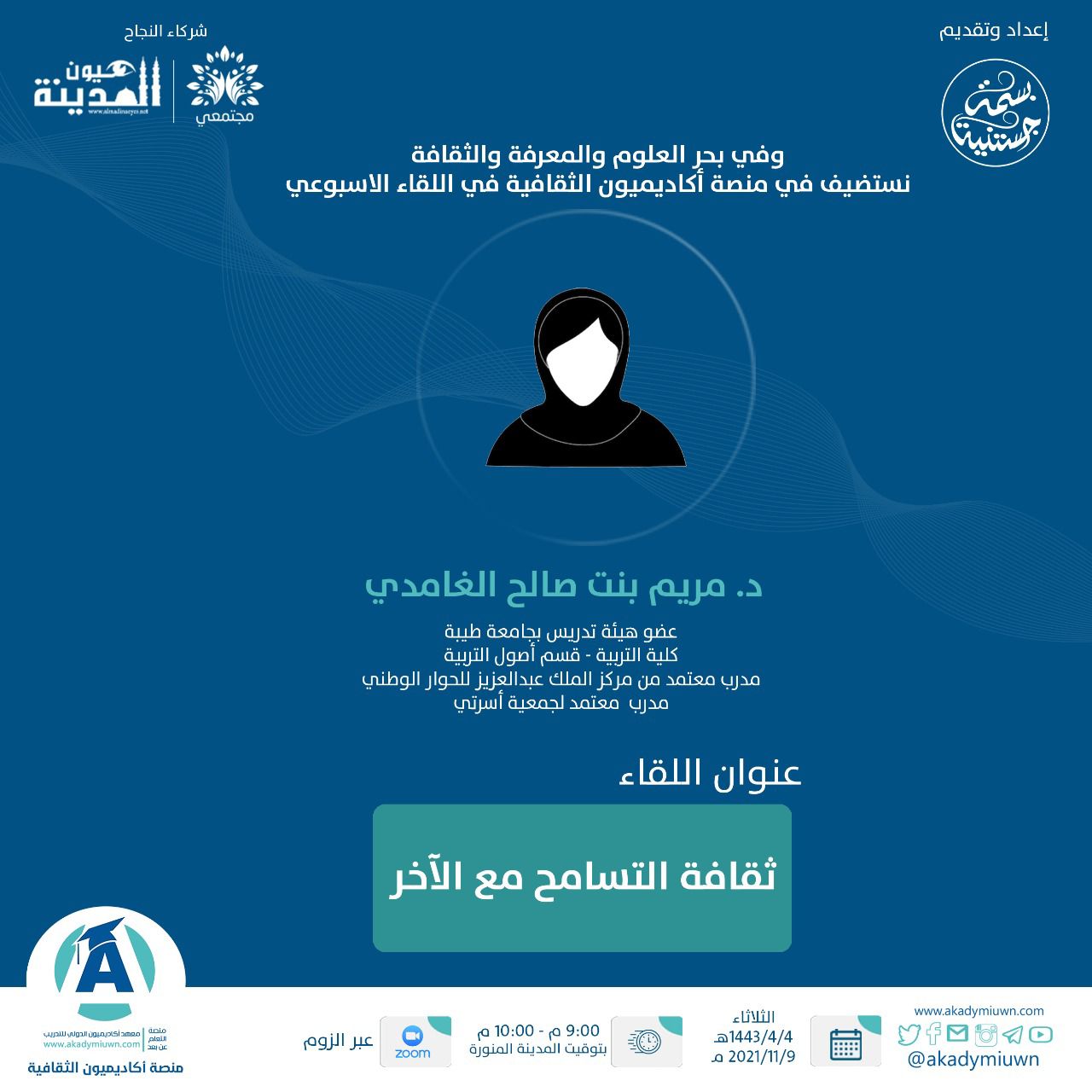
The ACADEMION Cultural Platform launches a non-profit platform that aims to disseminate knowledge and sciences through ambassadors, members, and advisors of the institute, and through a variety of reading, audio, and visual materials, weekly evenings every Tuesday evening to highlight topics of interest to contemporary society in all fields. The evenings feature a distinguished group of intellectuals and pioneers of science in various fields, and this Tuesday's evening, 4/4/1443 AH corresponding to 9/11/2021 AD, is titled (Culture of Tolerance with Others) presented by Dr. Maryam bint Saleh Al-Ghamdi, a faculty member at Taibah University in the Department of Educational Foundations, a certified trainer from the King Abdulaziz Center for National Dialogue, and a certified trainer for the Family Association. The evening began at 9 PM on Zoom, and the evening was presented by Dr. Mishal bin Yasin Al-Mahlawi.
Dr. Al-Ghamdi began the evening by pointing out that the topic of the culture of tolerance is a thorny issue and an important matter, as humans are social beings who cannot do without their fellow human beings. Unfortunately, in recent times, there has been a noticeable spread of the culture of excluding others, marginalizing them, or erasing them, which is a result of cultural legacies that may sometimes be political, affecting societies and showcasing a culture of violence and fanaticism, and the exclusion of others. The 'other' may differ within the homeland, or may differ outside the homeland, and may differ at the level of sect, gender, language, and civilization.
Dr. Al-Ghamdi clarified that the image of the 'other' appears in two forms: the one who differs in religion and the one who differs in sect. Generally, there are three fundamental pillars upon which the relationship with others is built:
The first pillar: difference, we must trust that we were created different. Allah Almighty says in His Holy Book: (And if your Lord had willed, He could have made mankind one nation, but they will not cease to differ). Allah, the Exalted, created people different in various forms, and this difference should ideally be a reason for interaction, giving, and cooperation, but unfortunately, it has become a cause for conflicts.
The second pillar: diversity, for diversity is a universal law. Allah created people diverse in colors, shapes, languages, dialects, races, religions, and species; for wisdom, which is to know one another. Allah says: (O mankind, indeed We have created you from male and female and made you peoples and tribes that you may know one another. Indeed, the most noble of you in the sight of Allah is the most righteous of you. Indeed, Allah is Knowing and Acquainted). Knowing and communicating allows a person to reach a stage of awareness of other civilizations and cultures.
The third pillar: coexistence, which is the attempt to establish a number of positive relationships with different others, which can be vital, flexible, and effective relationships.
Dr. Al-Ghamdi pointed out that the relationship with the 'other' suffers from several crises. She also noted that there is a sectarian issue in the Arab and Islamic world. Based on this reality, followers of sects face options: either the purpose and obligation that each sect seeks to impose its sect on others and obligate them to worship; because each sect believes in the validity of its sect and sees itself as tasked with spreading this sect, which is considered a problem from a legal standpoint. The second option is the animosity and conflict that Muslims currently find themselves in, where each sect member fortifies themselves with their sect and begins to mobilize their members against the other sect, leading to a state of tension, animosity, estrangement, and internal conflict that sometimes ends in civil war. The third option is coexistence, which is the best, but there is still a distance from coexistence, as each party must recognize the right of the followers of the other sect to adhere to their beliefs and practice their religious rituals; because everyone deals within the state as citizens, equal in rights and duties. Educational institutions have failed to bridge the gap between followers of sects, specifically between the Sunni and Shia sects; education is considered the gateway to reform any issue in society, so educational policies should be restructured to promote values of tolerance, pluralism, democracy, freedom, and equality, so that the culture of tolerance with others prevails within society.
Dr. Al-Ghamdi affirmed that in the Kingdom of Saudi Arabia, there are multiple and different sects, all of which enrich the jurisprudential field; because they share one Islamic foundation and differ in branches and interpretations. This diversity thrives under the auspices of Saudi Arabia, as the wise government has sought to establish a positive relationship system based on respecting this diversity within the framework of national unity to strengthen the social fabric. Dr. Al-Ghamdi also addressed the types of tolerance and then highlighted some advice that could help spread the culture of tolerance with others in society; so that the whole world, the Arab and Islamic world, and the local Saudi community can enjoy coexistence in peace and prosperity.