
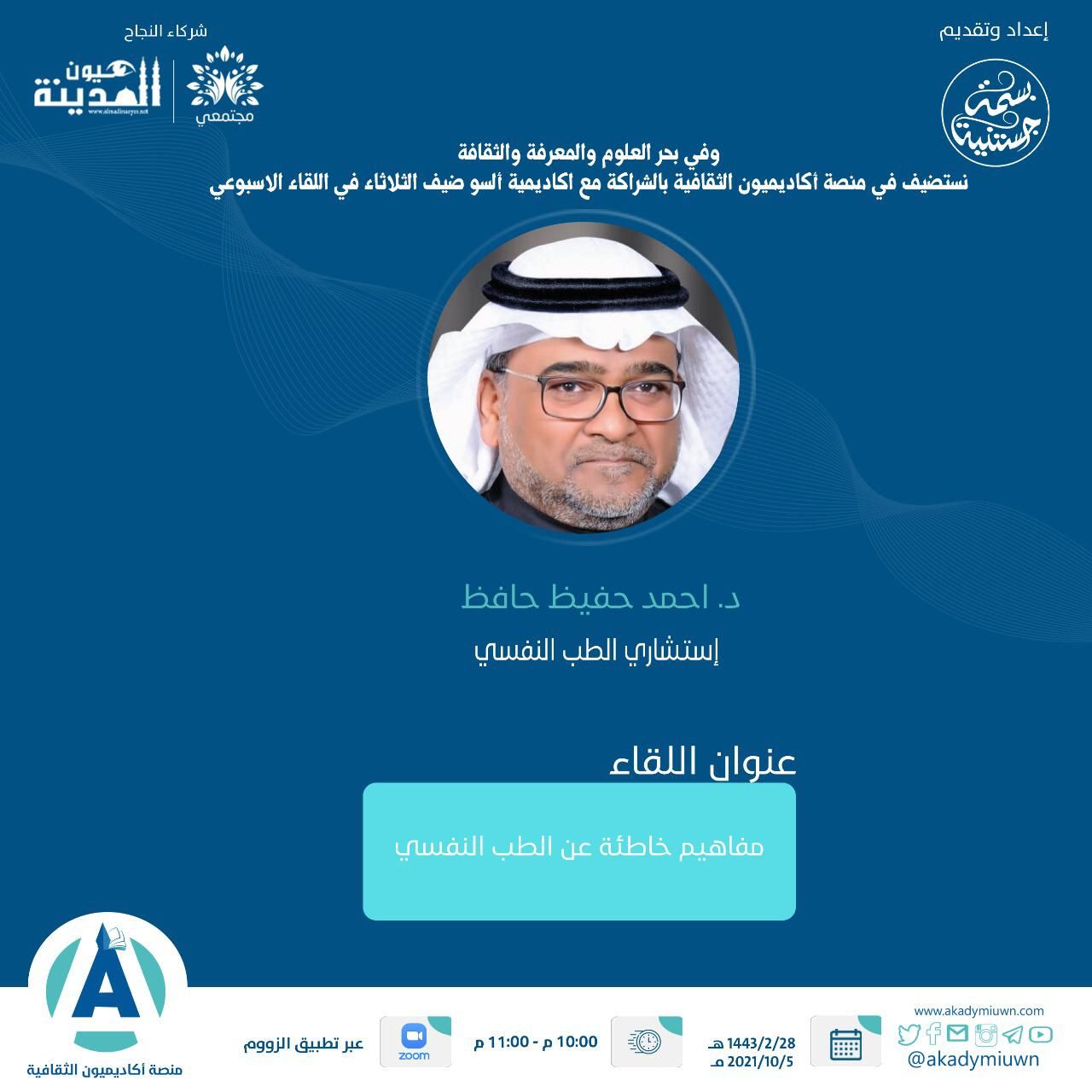
(Misconceptions about Psychiatry): An evening of the ACADEMIYON Cultural Platform
As part of the series of meetings presented by the ACADEMION Institute through the ACADEMION Cultural Platform, a non-profit platform dedicated to spreading knowledge and sciences through the ambassadors and advisors of the institute, and through a variety of reading, audio, and visual materials, the platform hosted an evening as part of a series of interactive evenings featuring a distinguished elite of intellectuals and pioneers of science in various fields. The evening sheds light on many important points related to psychiatry under the title (Misconceptions about Psychiatry) presented by Dr. Ahmed Hafiz Hafiz, a consultant psychiatrist in Medina. The evening began at 9 PM on Tuesday, corresponding to 28/2/1443 AH via Zoom, and was opened by Dr. Mishal bin Yasin Al-Mahlawi, founder of the ACADEMION International Institute for Training.
Dr. Hafiz began the evening discussing some misconceptions about psychiatry circulating in communities and presented a series of examples he encountered as a psychiatrist regarding those misconceptions. He clarified that some people believe that mental illnesses are directly related to jinn or demons, considering that anyone with strange emotions is possessed by jinn and seeks folk remedies, often disregarding psychiatry. They also attribute mental illness to "the evil eye, envy, and magic". A person who lacks awareness and understanding of mental illnesses hangs the mental illness on the hook of "jinn, the evil eye, and magic". There is no contradiction between treatment through legitimate spiritual healing mentioned in the prophetic tradition and medical treatment for both physical and mental illnesses. Additionally, there is a lack of awareness in understanding psychological treatment or that psychiatric medications are drugs that cause "addiction" or are akin to narcotics that everyone warns against using, which may deteriorate the mental patient's condition or exacerbate their illness and harm others.
Dr. Hafiz emphasized that the role of the psychiatrist ends with diagnosing the patient's condition and providing the necessary treatment, and the family's role comes next in observing the patient and administering the medication as directed by the doctor. Any disruption may put the patient at risk. It is also very important to raise awareness and educate to change the misconceptions that may exacerbate the psychological problem for the patient. There is a significant role for community members in this awareness and education, each in their field: teachers in the classroom, university professors in lecture halls, and every individual with their strength, knowledge, experience, and understanding participating in awareness and understanding, whether regarding physical or mental illnesses.
Dr. Hafiz clarified that among the misconceptions about mental illnesses is the demand to treat mental illness without any medication due to the belief that medications may cause addiction like narcotics, or due to their destructive side effects "as they think" that remain for life and do not go away, or the fear of public opinion "what people say" when visiting mental health hospitals or clinics, and replacing psychological treatment with folk medicine, or energy healing, etc., due to the many who claim to treat mental illnesses in ways and methods other than psychiatry. Thus, deception and sorcery have taken on different forms than before. The Prophet, peace be upon him, said: "Seek treatment, O servants of Allah, for Allah, the Exalted, did not send down a disease except that He sent down with it a cure, except for death and old age." He also said: "Allah did not send down a disease except that He sent down a cure for it, some know it and some do not." Therefore, the most important thing a person possesses in this life after religion is health, so caution against being lenient in this matter and going to non-specialists in psychiatry to obtain medication or treatment from them. Some people see medications as "narcotics", which is incorrect. Psychiatric medications are antipsychotics, antidepressants, and mood stabilizers, none of which lead to addiction in any way and are not considered narcotics. The percentage of minor tranquilizers in psychiatric medications does not exceed 5%, and they only lead to addiction in very rare cases if taken in very large doses for extended periods without medical supervision. However, if taken in specified doses, for certain periods, and under the supervision of a qualified medical professional, there are no repercussions of fear, doubt, or suspicion regarding those medications. These rumors and misconceptions must be dispelled. All medications have certain side effects that may affect the liver or specific areas of the body, and psychiatric medications may also have side effects that quickly disappear after the treatment period ends. Psychiatrists take into account when prescribing medication the principle of "the greatest benefit with the least harm", and they monitor the patient and conduct regular tests and analyses to ensure their health during the treatment period, as well as ensuring that they are on the right path to recovery.
Dr. Hafiz also mentioned that some people think that psychological treatment is only medication, which is incorrect. There are various and diverse psychological treatments according to the patient's needs, such as behavioral therapy, cognitive therapy, client-centered therapy, analytical therapy, and spiritual therapy "in how to elevate the human spirit, focusing on faith and spirituality, and how to improve the relationship with Allah, the Almighty". There is also sports therapy, nutritional therapy, and therapy through reorganizing a person's lifestyle "in terms of daily habits like sleeping early and waking up early".
Dr. Hafiz clarified that the first mental health hospital in the world was established during the Umayyad Caliphate in Damascus, and they did not view psychological treatment as a stigma or a derogatory perspective, nor as a cause of jinn, but rather they cared for it greatly. The hospital was located in a beautiful place in the midst of a lush garden, and they provided patients with the best types of food, funding the hospital from the Muslim treasury. They had a noble view of psychiatry and mental patients. The first to use treatment through electrical rhythm in a primitive way was Ibn Sina, a fact that is even obscured in modern medical books. Currently, there is an alternative to Ibn Sina's method of treatment through electrical rhythm using modern electrical devices for certain cases of mental patients, and this method is safe and has proven effective.
Dr. Hafiz also pointed out that most of the ideas found in people's minds about mental illness stemmed from old Arab films and series that carried unrealistic images of mental patients and psychological treatment. There is also a cultural heritage of distorted ideas about psychological treatment, and most mental illnesses are merely the result of traumas that may occur in life, causing wounds that are difficult to heal over the years. Psychological wounds are deeper and more painful than physical wounds, and psychological pain is more excruciating than physical pain.
Dr. Hafiz emphasized the necessity of uniting all layers of society across all scientific disciplines, each in their field, to raise awareness in communities about mental illnesses and their treatment. There should be primary psychological prevention regarding mental illnesses and early detection of mental illness to prevent complications. Women are more prone to depression than men by 25% compared to 12% for men. The life burdens that women may face are one of the most significant factors contributing to the increased likelihood of mental illnesses among them compared to men.
The evening concluded with Dr. Mishal Al-Mahlawi thanking Dr. Ahmed Hafiz for the valuable information he provided during the evening, and he also thanked the attendees of the evening.