
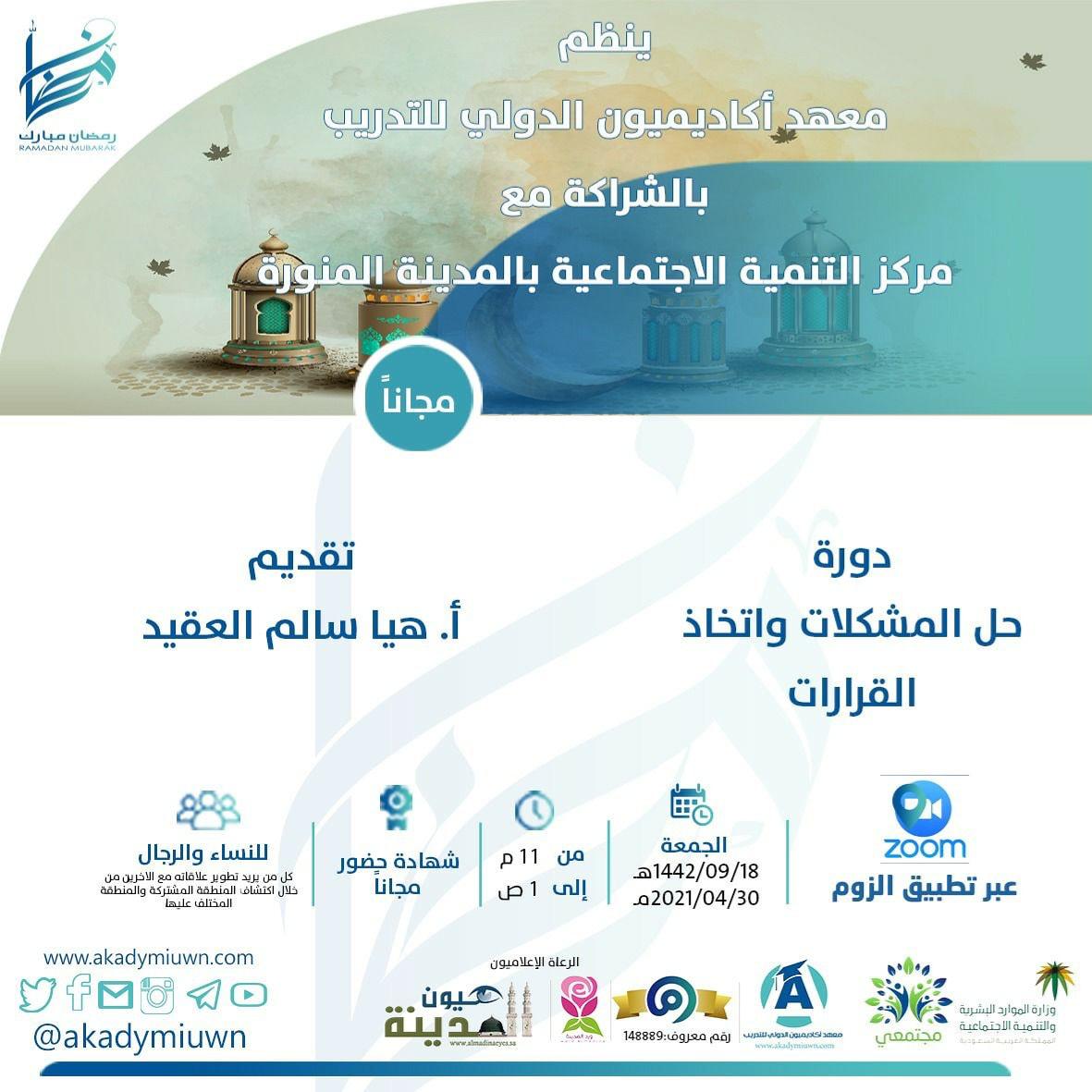
Problem Solving and Decision Making Course
The International Academy Institute for Training, in partnership with the Social Development Center in Medina, presented a course titled "Problem Solving and Decision Making" This will take place on Friday, the 18th of Ramadan, 1442 AH, at 11 PM for two hours, and the course was given by Ms. Haya Salem Mohammed Al-Aqeed, Assistant for Educational Affairs in the Northern Borders, an accredited trainer for the School Leadership Practitioner Program in the region, an accredited judge for the Education Excellence Award, and a member of the Office of Invitation and Guidance in Rafha. The course was presented by the media instructor Ms. Hattaf Tarabishi via Zoom (zoom) and live broadcast on YouTube by the ACADEMION International Training Institute.
Ms. Al-Aqeed started the course with the concept of a problem, which is the feeling or awareness of a difficulty that must be overcome to achieve a goal. It is also the difficulties we face when transitioning from one stage to another, which either prevent reaching the goal, delay it, or affect its quality. She mentioned that a problem has a life cycle that begins with emergence, then completion, and ends with a crisis, and that the best stage to solve a problem is at the emergence stage; because eliminating the problem at its beginning is easier and faster.
Ms. Al-Aqeed also explained the reasons for the occurrence of problems, and the steps to solve problems effectively. She mentioned the reasons for failure in problem-solving, which include not following a methodology in identifying and solving problems, lack of information or poor analysis of the problem, as well as the absence or limitation of the involvement of stakeholders, in addition to fear of failure, fear of innovation, fear of exchanging ideas, resistance to change, and stopping execution or neglecting follow-up and evaluation.
The trainer addressed some questions that require reflection, and pointed out important tips for problem-solving. She clarified the levels of commitment from the leader when solving problems, as well as how to make decisions. She also explained the levels of participation in problem analysis and decision-making, which consist of five levels, then presented obstacles to decision-making and shared some tips for decision-making.
At the end of the course, the electronic newspaper 'Eyes of the City' spoke with the trainer, where she added: I had the honor of collaborating with the ACADEMION International Institute for Training as my first beautiful experience with the institute, where the course topics varied between many subjects that included: defining the problem, what are the practical ways to solve it, what are the levels of leadership commitment in problem-solving and decision-making, understanding the levels of decision-making, what are the difficulties of decision-making, as well as the reasons for the failure of problem-solving, and I had approximately 329 participants.