(Media, Education, Development, Digital Citizenship, Sustainability, and Digital Public Opinion) The main discussions of the first day of the Smart Media Conference
As part of the activities of the second international inter-conference "Communication in the Smart Age – Digital Challenges and Future Visions", organized by ACADEMION International University, on Saturday, September 20, 2025, two scientific sessions were held addressing qualitative topics that combine media, education, sustainable development, digital citizenship, and digital public opinion.
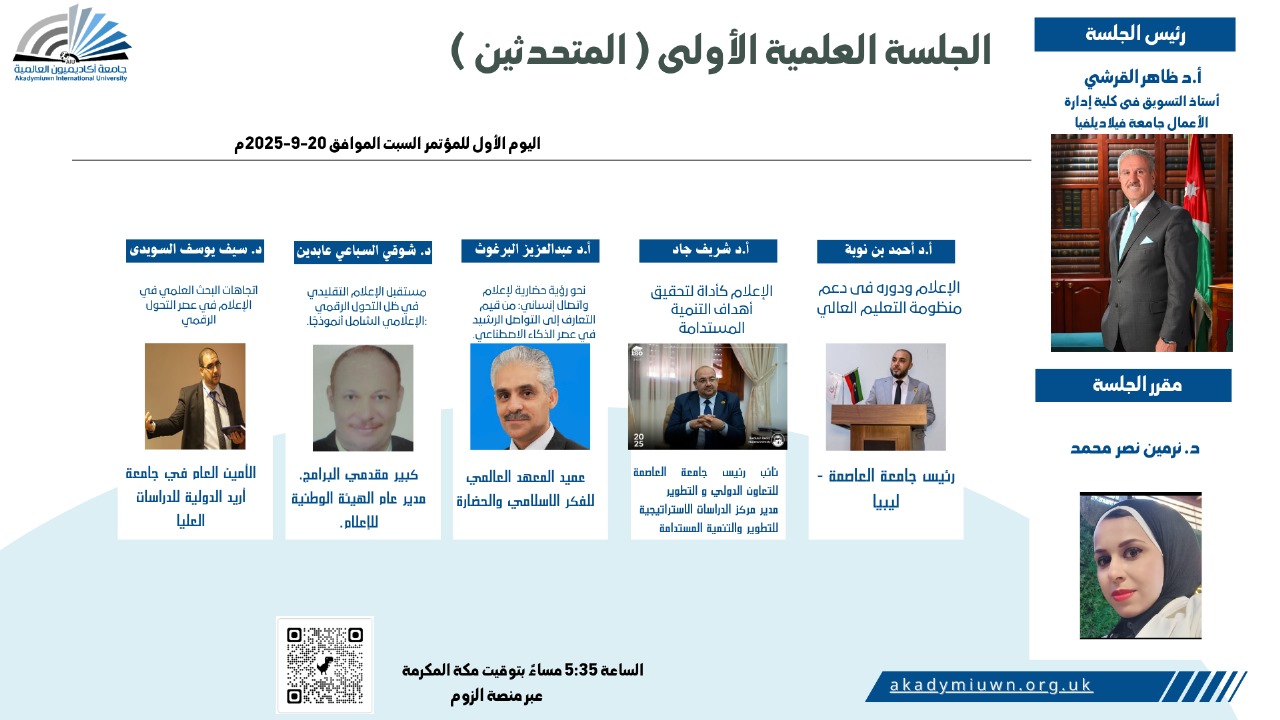
The first scientific session was chaired by Dr. Zaher Al-Qurashi, where Professor Ahmed Bin Nubah, President of the Capital University in Libya, reviewed the role of traditional and digital media in serving higher education institutions and their strategic plans and enhancing their position in society. This was followed by Professor Sherif Gad, the university's Vice President, who focused on media as a tool to achieve the seventeen sustainable development goals, considering it a key driver for positive change.
In another intervention, Professor Abdul Aziz Al-Barghouth, Dean of the Higher Institute for Islamic Thought and Civilization, spoke about the necessity of humanizing technology and artificial intelligence and employing them in a way that serves educational and human values. Dr. Shawqi Al-Sebai, Director General of the National Media Authority, also emphasized the importance of balance between traditional and digital media, affirming that artificial intelligence is a supportive tool that does not eliminate the role of humans or traditional media. The session concluded with an intervention by Professor Saif Youssef Al-Suwaidi, Secretary-General at the University of Arid International for Graduate Studies, who discussed the impact of the fifth industrial revolution and modern technologies such as artificial intelligence, big data, and the Internet of Things on the development of the media industry and content distribution methods.
The second scientific session was characterized by the diversity of its research papers, opening with Professor Salima Zidan presenting a paper titled Climate and Misinformation Online, highlighting the dangers of misinformation campaigns and their impact on public awareness and funding for environmental projects. This was followed by Dr. Kawthar Al-Salmi's paper titled Requirements for Activating Digital Citizenship Ethics among Youth, which emphasized the importance of ethics as a foundation for protecting society from digital deviations through religious, cultural, and social requirements.
In the sustainability axis, Dr. Alawi Eidros presented his paper on the importance of teaching environmental accounting, stressing its inclusion in university curricula to raise student awareness and support curricula with issues of environment and society. Then, Professor Nermin Mohamed Askar and Professor Huda Mahmoud Flatah presented a joint research titled Design Thinking for Employing Arabic Fonts Using Modern Technology, which explored the potential for innovation in Arabic fonts through artificial intelligence while preserving the Arab cultural character.
The session concluded with a paper by Professor Mariam Ihab titled The Production of Digital Public Opinion and Its Impact on Political Decision-Making, which confirmed that digital public opinion has become an active and influential force in decision-making and government policies, especially in current issues like Gaza, where it acts as a dynamic factor in shaping policies and directing public discourse.