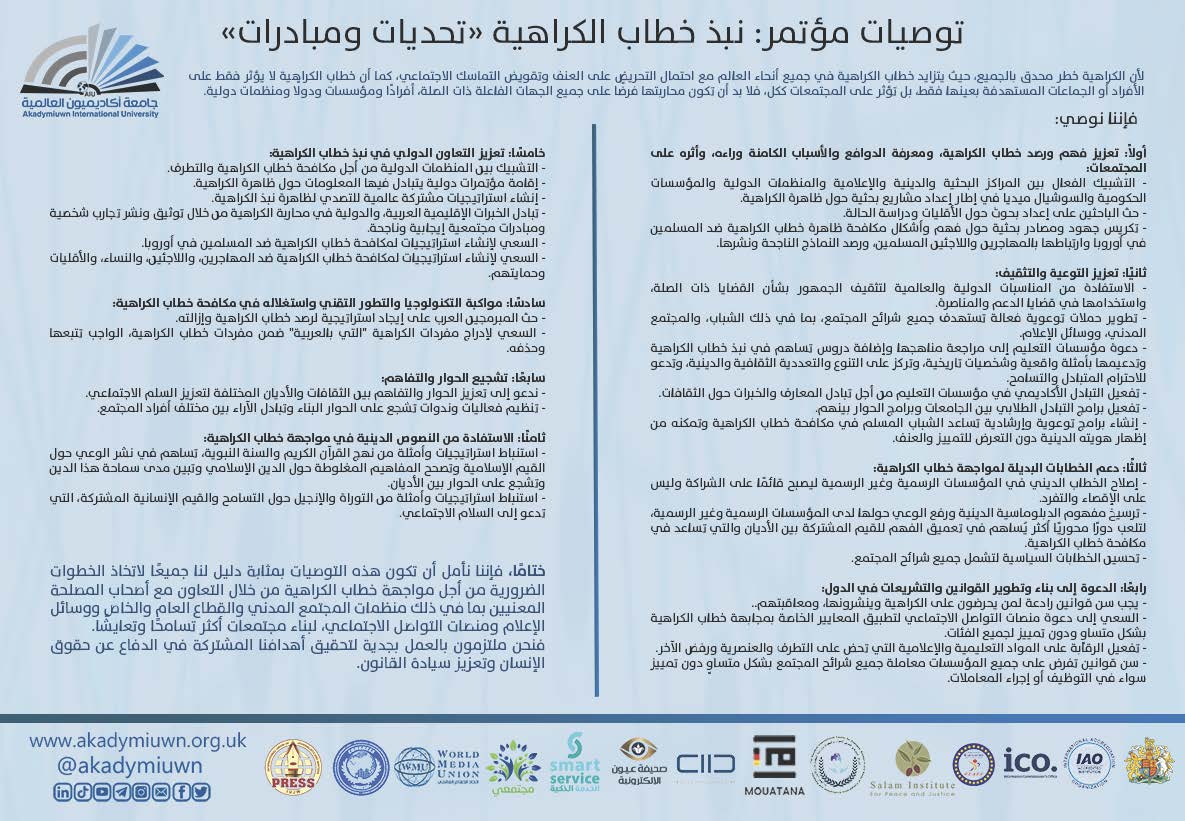
Conference recommendations
Because hatred is a looming danger for everyone, as hate speech increases worldwide with the potential to incite violence and undermine social cohesion, hate speech does not only affect specific individuals or targeted groups, but it impacts communities as a whole. Therefore, combating it must be an obligation for all relevant actors, individuals, institutions, states, and international organizations.
We recommend:
First: Enhancing understanding and monitoring of hate speech, knowing the motivations and underlying causes behind it, and its impact on communities:
- Effective networking between research, religious, media, international organizations, government institutions, and social media in preparing research projects on the phenomenon of hatred.
- Encouraging researchers to conduct studies on minorities and case studies.
- Devoting efforts and research resources to understanding and combating hate speech against Muslims in Europe and its connection to Muslim migrants and refugees, monitoring successful models and disseminating them.
Second: Enhancing awareness and education:
- Utilizing international and global occasions to educate the public about relevant issues and using them for advocacy and support.
- Developing effective awareness campaigns targeting all segments of society, including youth, civil society, and media.
- Inviting educational institutions to review their curricula and add lessons that contribute to rejecting hate speech, supported by real examples and historical figures, focusing on diversity and cultural and religious pluralism, and calling for mutual respect and tolerance.
- Activating academic exchange in educational institutions to share knowledge and experiences about cultures.
- Activating student exchange programs between universities and dialogue programs among them.
- Establishing awareness and guidance programs that help Muslim youth combat hate speech and empower them to express their religious identity without facing discrimination and violence.
Third: Supporting alternative discourses to counter hate speech:
- Reforming religious discourse in official and unofficial institutions to be based on partnership rather than exclusion and singularity.
- Establishing the concept of religious diplomacy and raising awareness about it among official and unofficial institutions, to play a more pivotal role in deepening understanding of the shared values among religions that help combat hate speech.
- Improving political discourses to include all segments of society.
Fourth: Calling for the building and development of laws and legislations in countries:
- Deterrent laws must be enacted against those who incite and spread hatred, and punish them.
- Seeking to call on social media platforms to apply standards for combating hate speech equally and without discrimination for all groups.
- Activating oversight on educational and media materials that incite extremism, racism, and rejection of others.
- Enacting laws that require all institutions to treat all segments of society equally without discrimination, whether in employment or conducting transactions.
Fifth: Enhancing international cooperation in rejecting hate speech:
- Networking between international organizations to combat hate speech and extremism.
- Holding international conferences to exchange information on the phenomenon of hatred.
- Creating global joint strategies to address the phenomenon of rejecting hatred.
- Exchanging regional Arab and international experiences in combating hatred by documenting and disseminating personal experiences and positive and successful community initiatives.
- Seeking to establish strategies to combat hate speech against Muslims in Europe.
- Seeking to establish strategies to combat hate speech against migrants, refugees, women, and minorities and to protect them.
Sixth: Keeping pace with technology and technical development and exploiting it in combating hate speech:
- Encouraging Arab programmers to find a strategy to monitor and remove hate speech.
- Seeking to include hate vocabulary "in Arabic" within the vocabulary of hate speech that must be tracked and removed.
Seventh: Encouraging dialogue and understanding:
- We call for enhancing dialogue and understanding between different cultures and religions to promote social peace.
- Organizing events and seminars that encourage constructive dialogue and exchange of opinions among various members of society.
Eighth: Utilizing religious texts in confronting hate speech:
- Deriving strategies and examples from the approach of the Holy Quran and the Sunnah that contribute to raising awareness about Islamic values and correcting misconceptions about Islam, showing the tolerance of this religion and encouraging dialogue between religions.
- Deriving strategies and examples from the Torah and the Gospel regarding tolerance and shared human values that call for social peace.
In conclusion, we hope that these recommendations serve as a guide for all of us to take the necessary steps to confront hate speech through collaboration with relevant stakeholders, including civil society organizations, the public and private sectors, media, and social media platforms, to build more tolerant and coexisting communities.
We are committed to working diligently to achieve our common goals in defending human rights and promoting the rule of law.