
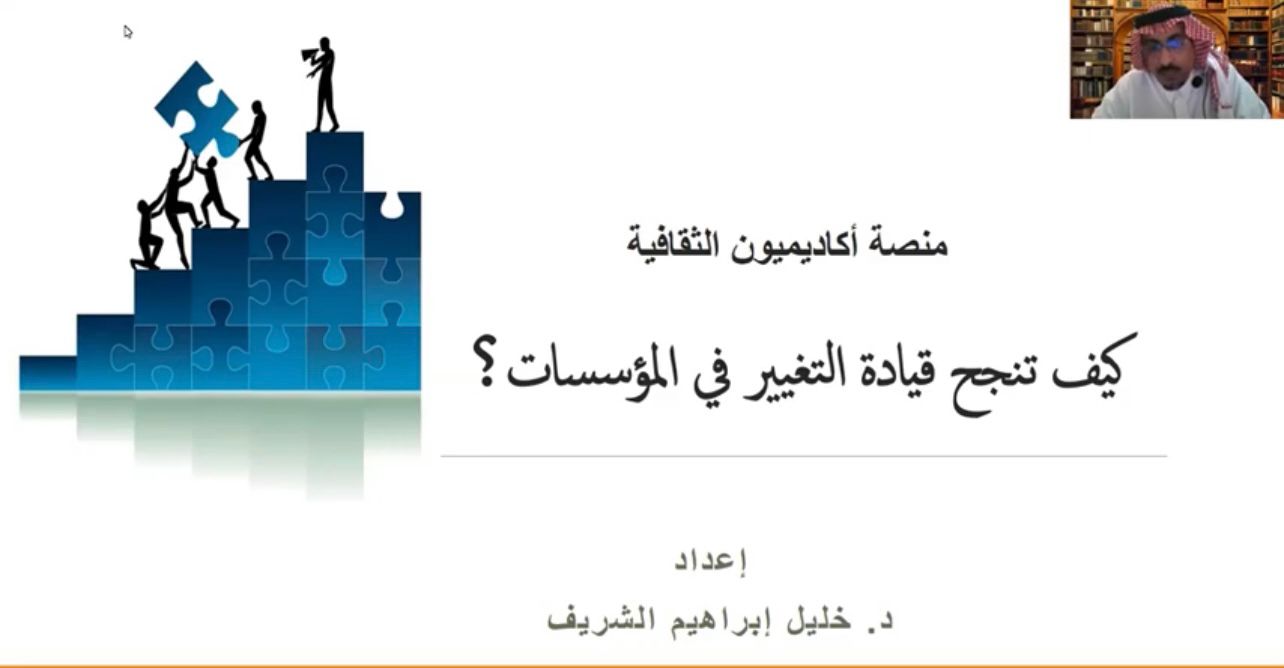
Evening of the ACADEMION Cultural Platform titled (How to Successfully Lead Change in Institutions?)
The ACADEMION Cultural Platform, a non-profit platform dedicated to disseminating knowledge and sciences through ambassadors, members, and advisors of the institute, organized an evening titled (How to Succeed in Leading Change in Institutions?) on Tuesday, 15/6/1443 AH corresponding to 18/1/2022 AD, presented by Dr. Khalil Ibrahim Al-Sharif, PhD in Educational Administration and Supervisor of Training and Scholarship at Jeddah Education. The evening began at 9 PM via Zoom, and it was moderated by Dr. Najat Mohammed Al-Saigh.
Dr. Al-Sharif started the evening by discussing the concept of leadership, pointing out that there is a significant connection between the concepts of change and leadership. There is considerable confusion regarding the concept of leadership, as most leadership concepts focus on influence, and most definitions of leadership revolve around influence. It is noted that most definitions of leadership define it through two main directions: influence and the group that is influenced.
The doctor believes that influence alone does not explain leadership or, rather, does not provide a comprehensive meaning of leadership, and that the group, just as it is influenced by the leader, also influences him. The process of influence exists from both sides. The doctor also mentioned that 'Benjamin Kessler' believed that humanity should be restored to the original ancient concept of leadership, a concept that prevailed before the training of leaders turned into a profitable business.
The doctor clarified the difference between management and leadership, noting that misleading information has spread in the negative aspect, always placing leadership in the positive side. He mentioned that all good and positive matters are important to be present in both the leader and the manager alike, as well as all negative and wrong matters should be avoided by both the manager and the leader alike. He then explained the essential differences between management and leadership, which lie in strategies rather than in natural practices. Leadership races ahead of events, while management keeps pace with events. Leadership seeks to create change, while management adapts to the complexities of the current situation, among other important fundamental differences.
The doctor addressed the requirements for successful change leadership, which lie in leading change for individuals, culture, and legislation. He then presented a model of the most influential leadership, which is 'Peter Drucker', and mentioned the most important characteristics of effective change leaders. He then moved on to the difficulties of leading change, which he explained through eight points, starting with raising the sense of the need for change and ending with institutionalizing the new aspects.