
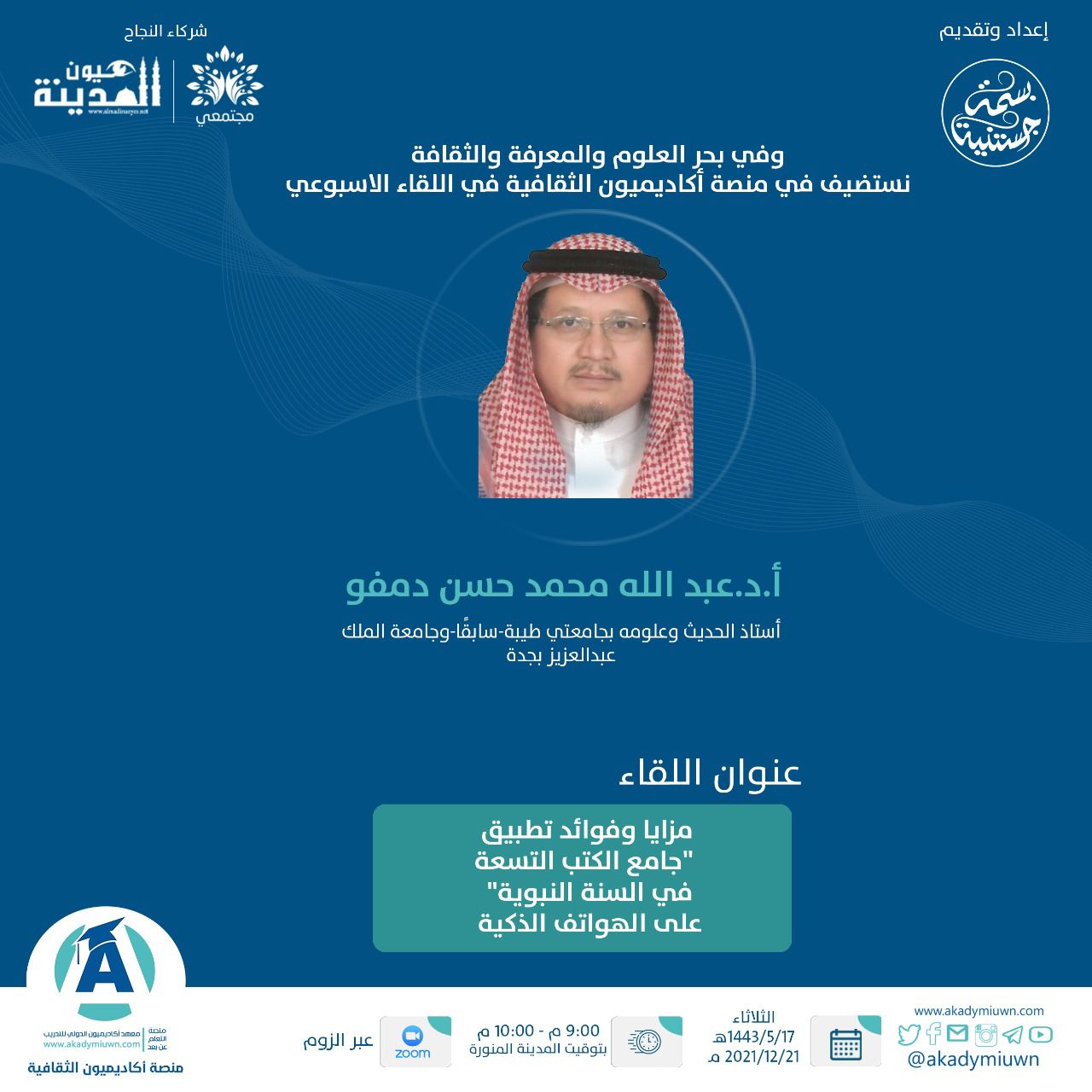
An Evening of the ACADEMION Platform: Advantages and Benefits of the (Collection of the Nine Books in the Prophetic Sunnah) Application on Smartphones
The ACADEMION cultural platform launches a non-profit platform that aims to disseminate knowledge and sciences through ambassadors, members, and advisors of the institute, and through a variety of reading, audio, and visual materials, weekly evenings every Tuesday evening to highlight topics of interest to contemporary society in all fields. The evenings feature a distinguished group of intellectuals and pioneers of science in various fields, and this Tuesday's evening 1443/5/17 AH corresponding to 2021/12/21 AD is titled: (Advantages and Benefits of the "Collection of the Nine Books in the Prophetic Sunnah" Application on Smartphones) presented by Professor Dr. Abdullah Muhammad Hassan Damfo, a professor of Hadith and its sciences at Taibah University previously and King Abdulaziz University in Jeddah. The evening started at 9 PM on the Zoom application, and the evening was presented by Dr. Basma Ahmed Jastania.
Dr. Damfo talked about the documentation of the Sunnah before the six books, and explained that the Prophet, peace be upon him, prohibited writing Hadith during his time to avoid mixing it with the writing of the Holy Quran. The first to document the Sunnah comprehensively was Imam Muhammad ibn Muslim al-Zuhri, and the third century AH is considered the golden age for documenting the Sunnah, during which the authors of the six books and their works appeared.
Dr. Damfo also discussed the six imams and their works in the Prophetic Hadith. At the beginning of the fourteenth century AH, three books were added to the six books: the Muwatta of Malik, then Imam Ahmad ibn Hanbal, and then Abdullah ibn Abdulrahman al-Darami.
Dr. Damfo pointed to the time when the term 'the nine books' appeared, which emerged when a group of Orientalists compiled the book "The Indexed Dictionary of the Words of the Prophetic Hadith," where they indexed the six books, the Sunan of al-Darami, the Muwatta of Malik, and the Musnad of Imam Ahmad. This compilation was old and took 33 years to complete. He clarified that the largest collection of Hadith books is the Musnad of Imam Ahmad ibn Hanbal, which is divided into 6 volumes, containing nearly 28,000 Hadiths. In 1413 AH, the Custodian of the Two Holy Mosques, King Fahd bin Abdulaziz, may Allah have mercy on him, ordered the collection of manuscript copies and the verification of the book, providing it with a suitable scientific service, transforming what was in 6 volumes into 50 parts.
Dr. Damfo explained the importance of the nine books and the role of the Sakhr application in serving the Prophetic Sunnah, indicating that the Sakhr application is the first computer program containing 62,000 Hadiths from the Prophetic Sunnah. The application is not limited to Hadiths only but also includes explanations and various services for the nine books, such as the Hadith Encyclopedia published by Sakhr Company, the second version of the "Harf" program which added "the nine books and their explanations," and the third version from the Custodian of the Two Holy Mosques' government in preserving, disseminating, and maintaining the Sunnah, which is the latest version from 2014 AD that added texts to the nine books, making it 90 books.
Dr. Damfo explained the "Collection of the Nine Books" program, which is an application on smartphones belonging to the endowment of the mother of Badr Al-Rajhi and the Arab House for Information Technology. The application contains a comprehensive search for any Hadith from the Prophetic Hadith, in addition to explanations of the Hadiths and narrators, adding the ruling of the Hadith, and the ability to share Hadiths with anyone through social media programs, along with many other features that enhance the presentation of the Hadith.