
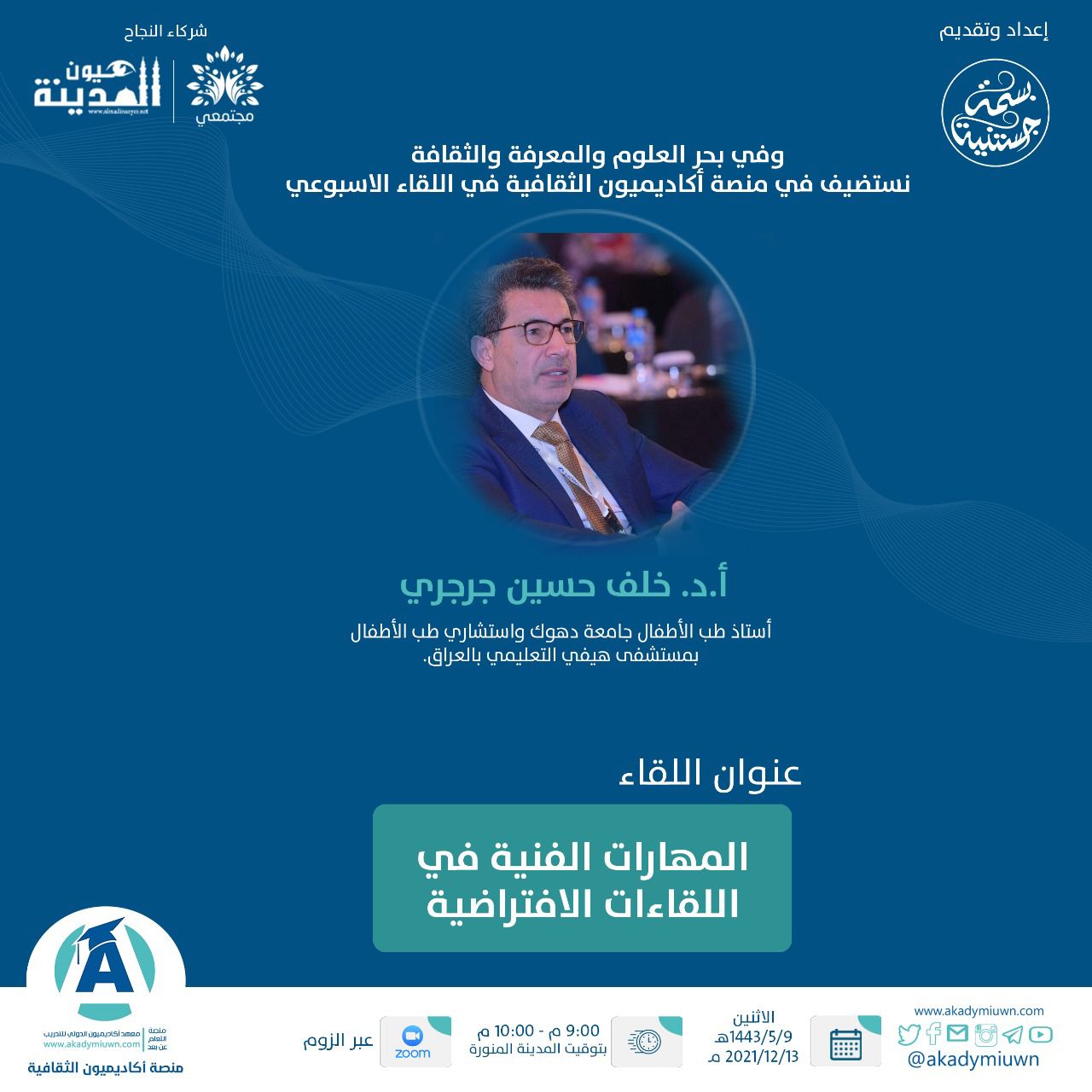
(Technical Skills in Virtual Meetings): Weekly Evening of the ACADEMION Platform
The ACADEMION cultural platform launches a non-profit platform that aims to disseminate knowledge and sciences through ambassadors, members, and advisors of the institute, and through a variety of reading, audio, and visual materials, weekly evening sessions to highlight topics of interest to contemporary society in all fields. The sessions feature a distinguished group of intellectuals and pioneers in various fields, and the session on Monday 9/5/1443 AH corresponding to 13/12/2021 AD titled: (Technical Skills in Virtual Meetings) was delivered by Professor Dr. Khalaf Hussein Jirjari, Professor of Pediatrics at Duhok University, and a pediatric consultant at Hevi Teaching Hospital in Iraq. The session began at 9 PM on Zoom, and was presented by Dr. Sonia Ahmed Maliki.
Dr. Jirjari began the session with the components of the educational environment, which consists of: the lecturer who delivers the lecture, the hall or place prepared for the meeting, and the audience; the availability of these three elements contributes to the success of the lecture and makes it ideal. He then mentioned the importance of credibility and pauses in virtual lectures to gain the audience's trust. Trust in the lecture comes from three aspects: the message the lecturer conveys to the audience, the way the lecture is delivered, and the visual effects.
Dr. Jirjari also discussed how to keep the audience attentive during the lecture through eye contact, as well as through movement, voice nature, facial expressions, and features. He then explained how to gain the trust of others? This can be achieved through distinctive clothing and appearance, language, and sometimes through brief pauses. He clarified how to make others interact during the lecture? This is done through eye contact; looking at the camera in virtual lectures makes the audience think that the lecturer is looking at them. Body language is also very important; sitting in an inappropriate manner during lectures is unacceptable. He emphasized that the tone of speech should not be slow and uniform but should sometimes increase and decrease. The lecturer should speak calmly, and the volume and speed of the voice are very important; one should not speak too quickly or too slowly. He mentioned that the method of delivery is very important in virtual meetings, so one should focus on using body language even if the lectures are behind screens.
Dr. Jirjari explained the important points that the lecturer should avoid in meetings or lectures, such as not saying: 'Does this work?' as it implies that he did not check the equipment before the meeting. In meetings without a session chair, the conversation should be in the plural form. The lecturer should not ask, 'Are there any questions?' as this implies that the audience should not have questions, reinforcing that assumption with the question. Instead, the lecturer should say: 'What questions do you want to ask?' This encourages the audience to ask questions. He also mentioned that the lecturer should not apologize if the time is late or for any other reason; rather, he should thank the audience for being present to listen to the lecture. He added that there should be brief pauses during the delivery, and if someone comments during the lecture, one should not respond with a sentence containing the word 'but,' but rather correct the statement with a phrase that affirms the correction without offending the person who made the comment.
Dr. Jirjari also pointed out the most important things to maintain during the lecture, such as ensuring that the audience and recipients reach a stage where they enjoy the lecture. There is no harm in having some humor during the lecture, and there should be opportunities for interaction from the audience. Focus should not be on one person during the lecture, and no one from the audience should be disturbed as it annoys others. He also discussed how to build the lecture and the things the lecturer fears, then he touched on the important points to consider before the meeting regarding electrical devices and ensuring internet sources are available during and before the meeting, having a backup device in case of internet failure, the importance of saving the lecture in multiple locations, and ensuring everything is ready before starting the meeting. He then talked about good and poor visual effects, in addition to good presentation and choosing appropriate colors, avoiding information stuffing in slides, and adding expressive images and other additions that add value and benefit to the slides.